
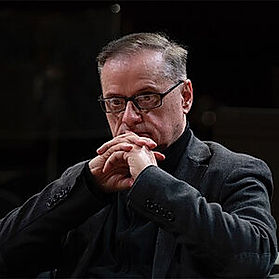
Gérard Pesson
For solo piano
2026
Études pour piano
~13'

Media
Score

About
Instrumentation
Piano
Commissioned by
Ensemble Mêtis
Dedicated to
Premiere
Alternative Stage of the Greek National Opera of Athens, May 23, 2026
Computer Music Designer
Publisher
Important Note
Programme Note
It has always seemed to me that writing that is “addressed” — intended for a particular performer whose personality, playing, and musical choices one knows — possesses a kind of rightness that is harder to achieve when writing for performers one does not know.
Stéphanos Thomopoulos and I had the idea of working together, in close accord, since we have known each other for a long time: our first collaboration was around his thesis on the piano works of Iannis Xenakis, music he plays like no one else. He has regularly performed my piano music, notably the two Vexierbilder cycles, and it seemed to us that this now well-established artistic companionship could give rise to a new work: a cycle for piano.
I thought of studies, because Stéphanos Thomopoulos’s virtuosity is legendary and dazzling.
Stéphanos’s commitment to the Ensemble Mêtis further strengthened our desire for this project, placing it within a powerful dynamic and opening the way to future developments.
The writing of these studies therefore unfolded in close collaboration with the person who would play and premiere them in his own country, in Athens. For a composer, who often works alone, it is a deeply stimulating experience to interact with the performer. Stéphanos thus took part in every stage of the conception of the writing, and even of the editing. I would often call him so that, through his answers to my questions, he could help me resolve a problem I had encountered while composing. And even during the work of performance and rehearsal, we continued to change many details of the score. One can truly speak here of co-creation.
In writing these studies, it was of course necessary to decide what was meant by the word. I define it as a particular musical character involving, through the material, the figuration, and the tempo, a specific pianistic difficulty. Each study is therefore strongly characterized. These studies have another technical particularity: they all require what is known as the sostenuto pedal, which makes it possible to select the resonances of certain chosen notes. In this way, the sustain pedal is used less, allowing the articulation of phrases, rhythms, and chords to be highlighted with great precision, while enveloping the music in a light harmonic halo.
The Étude au bourdon presents itself as a long melodic phrase in the right hand, floating over the constant resonances of four Ds in four different octaves, with two C-sharps adding spice to the resonance. The Étude aux notes répétées has a self-explanatory title: the repetition of notes is often carried out here by both hands, a difficult technique that releases tremendous rhythmic energy. The Étude aux accords is made up of one hundred chords, all different, phrased within a very broad harmonic halo, with slowings-down, arpeggiations, and suspensions that give the impression of a kind of music box. The Étude aux graves is played mainly in the three lowest octaves of the piano, with short, nervous sounds, slightly jazzy in character, and a final escape towards the two highest notes of the instrument. The Étude nuage is built on suspended chords which I might describe as being in “boiling” motion, with the two hands moving in contrary or parallel motion at great speed, so that the harmonies follow one another very rapidly, sometimes almost imperceptibly, like a kind of kaleidoscope of sonic colours. The Étude ruban is no doubt the most virtuosic; it is based on a rhythmic writing and tempo derived from the finale of Chopin’s Second Sonata, although the style bears no relation to it. I have always loved this idea of an infinite melody, of a ribbon, stated here mainly by the right hand, with the appearance of two harmonic spectra, on the note C and then on the note E; the study ends with the ghostly resonances of the notes G and C, in a perfect cadence that brings the cycle to a close.
Gérard Pesson
May 2026